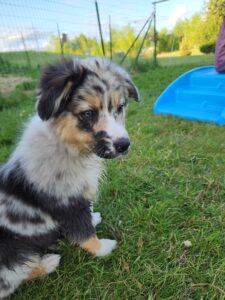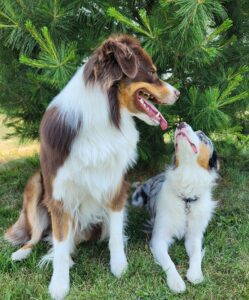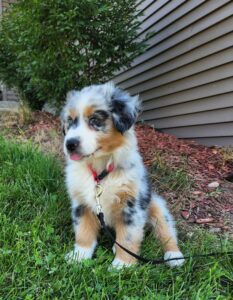
INTRO
If you’re wondering whether an Australian Shepherd can be a service dog, the honest answer is—sometimes.
Australian Shepherds are intelligent, loyal, and highly trainable. However, those same traits can also make them more challenging than other breeds typically used for service work.
Success depends less on the breed itself and more on the individual dog’s temperament.
WHAT MAKES A GOOD SERVICE DOG
Before looking at the breed, it’s important to understand what service work actually requires.
A service dog must be able to:
• remain calm in busy environments
• handle noise, movement, and unpredictability
• stay focused on their handler
• recover quickly from stress
• remain neutral around people and other animals
These qualities go beyond training—they are rooted in temperament.
WHERE AUSTRALIAN SHEPHERDS EXCEL
Australian Shepherds can make excellent service dogs in the right situations.
They are known for:
Intelligence
They learn quickly and can perform complex tasks with consistency.
Strong Bond with Their Handler
Aussies naturally connect with their person, which supports service work that requires attention and responsiveness.
Work Ethic
They enjoy having a job and often thrive when given structure and purpose.
WHERE THEY CAN STRUGGLE
This is where honesty matters.
Not every Australian Shepherd is suited for service work—and many are not.
Sensitivity to Sound and Movement
Aussies are herding dogs, which means they are often highly aware of their environment.
This can lead to:
• reacting to sudden movement
• heightened awareness of noise
• difficulty staying neutral in busy spaces
Excitability
Some Australian Shepherds have higher energy levels and can become overstimulated without the right foundation.
Need for Structure
They do not typically succeed in hands-off homes.
They require:
• consistent training
• clear expectations
• ongoing engagement
TEMPERAMENT MATTERS MORE THAN BREED
This is the most important point.
Even within the same litter, temperament can vary widely.
Some puppies may show:
• high confidence
• low sensitivity
• strong human focus
Others may not.
This is why selecting the right candidate is critical.
Training cannot replace temperament—it can only develop what is already there.
WHAT TO LOOK FOR IN AN AUSSIE SERVICE DOG CANDIDATE
When evaluating an Australian Shepherd for service work, key traits include:
• confidence in new environments
• low sound and sight sensitivity
• ability to recover quickly
• strong focus on people
• stable, neutral behavior
These traits give the dog the ability to function reliably in real-life situations.
REALISTIC EXPECTATIONS
Even with the right dog, service work is a process.
It requires:
• time
• consistent training
• exposure to real-world environments
Not every dog will succeed—and that’s part of responsible selection.
THE MATCH DOT PUP APPROACH
At Match Dot Pup, we place a strong emphasis on temperament, early development, and thoughtful evaluation when identifying potential service dog candidates.
From an early age, puppies are introduced to a variety of sounds, surfaces, environments, handling experiences, and socialization opportunities designed to help build confidence and adaptability. We carefully observe traits such as recovery, motivation, human focus, sensitivity levels, and willingness to engage as puppies continue to develop.
Our goal is to help create strong foundations that support long-term success for both the dog and their future handler.
FINAL THOUGHTS
So, can an Australian Shepherd be a service dog?
Yes—but only the right one.
Success depends on selecting a dog with the correct temperament and then developing that foundation through training and experience.
When both pieces come together, Australian Shepherds can become highly capable and reliable service dogs.
🐾 READY TO LEARN MORE?
If you’re considering a service dog candidate and want to better understand the process:
👉 Learn more about our Service Dog Program
Service Dog Program
👉 See how we identify and develop candidates
Service Dog Training & Outcomes
🐾 RELATED READING
How to Choose a Service Dog Candidate (What Actually Matters)
Puppy Temperament: Why It Matters More Than You Think
Understanding Your Dog’s Body Language
Developing Impulse Control
Understanding Puppy Exercise